How to Read a Cannabis COA: A Minnesota Lab Results Guide
A line-by-line walkthrough of a Minnesota cannabis COA: total THC math, what ND and LOQ mean, and the state testing limits products must pass.
How to read cannabis lab results (COAs) at Minneapolis dispensaries
A certificate of analysis (COA) is the lab report behind every cannabis product sold at a licensed Minnesota dispensary. It shows how much THC and CBD a batch contains and whether that batch passed state tests for microbes, mold toxins, heavy metals and pesticides. Any Minnesota dispensary has to share those results on request.
Key takeaways
- A COA covers one batch. Match the batch number on the COA to the batch number on the product’scompliance label before trusting the report.
- Minnesota requires every batch to be tested by a lab licensed by the Office of Cannabis Management (OCM), and to pass the state standards before it can be sold.
- Total THC is the potency number to check on flower: delta-9 THC plus THCA multiplied by 0.877.
- “ND” means not detected.
- “<LOQ” means less than the limit of quantitation: a compound may be present, but below the amount the lab can reliably measure.
- Under Minn. Stat. 342.61, licensed cannabis and hemp businesses must make test results available to the public on request.
What a cannabis COA is and why Minnesota requires one
A cannabis COA is a report from a testing lab that lists a batch’s cannabinoid content and its results on required safety and potency tests. Minnesota law bars a licensed business from selling a batch until a representative sample has been tested by a licensed lab and found to meet state standards (Minn. Stat. 342.61).
Since Jan. 1, 2026, testing must happen at an OCM-licensed facility. The rules labs follow are OCM’s technical standards for sampling and testing, version 2.0, in effect since July 1, 2026.
Testing matters because a label is only as accurate as the numbers behind it. A 2023 study in PLOS ONE tested 23 flower samples from 10 Colorado dispensaries, and about 70% came in more than 15% below the THC printed on the label. Minnesota’s standards require measured cannabinoid content to land within 15% of the label claim.
What Minnesota labs test for, by product type
| Product type | Required testing under OCM standards v2.0 |
| Dried flower | Potency, microbes, mycotoxins, heavy metals, pesticides, foreign matter, stability |
| Rosin | Potency, microbes, mycotoxins, heavy metals, pesticides, stability |
| Solvent-extracted concentrates | Everything rosin gets, plus residual solvents |
| Manufactured products, such as edibles | Potency, homogeneity (dose consistency across servings), microbes, stability |
An edible’s COA often lists fewer tests than a flower COA. The flower and extract used to make it were tested earlier in the supply chain, so the finished product’s panel focuses on potency, dose consistency across servings, microbes and stability.
An annotated COA: what each section means
Most Minnesota COAs follow the same order: lab and product details, dates and an overall result, the cannabinoid profile, an optional terpene profile, then the safety panels. The sample below labels each section. Its numbers are illustrative and don’t describe a real product; use it as a map when reading a real report.
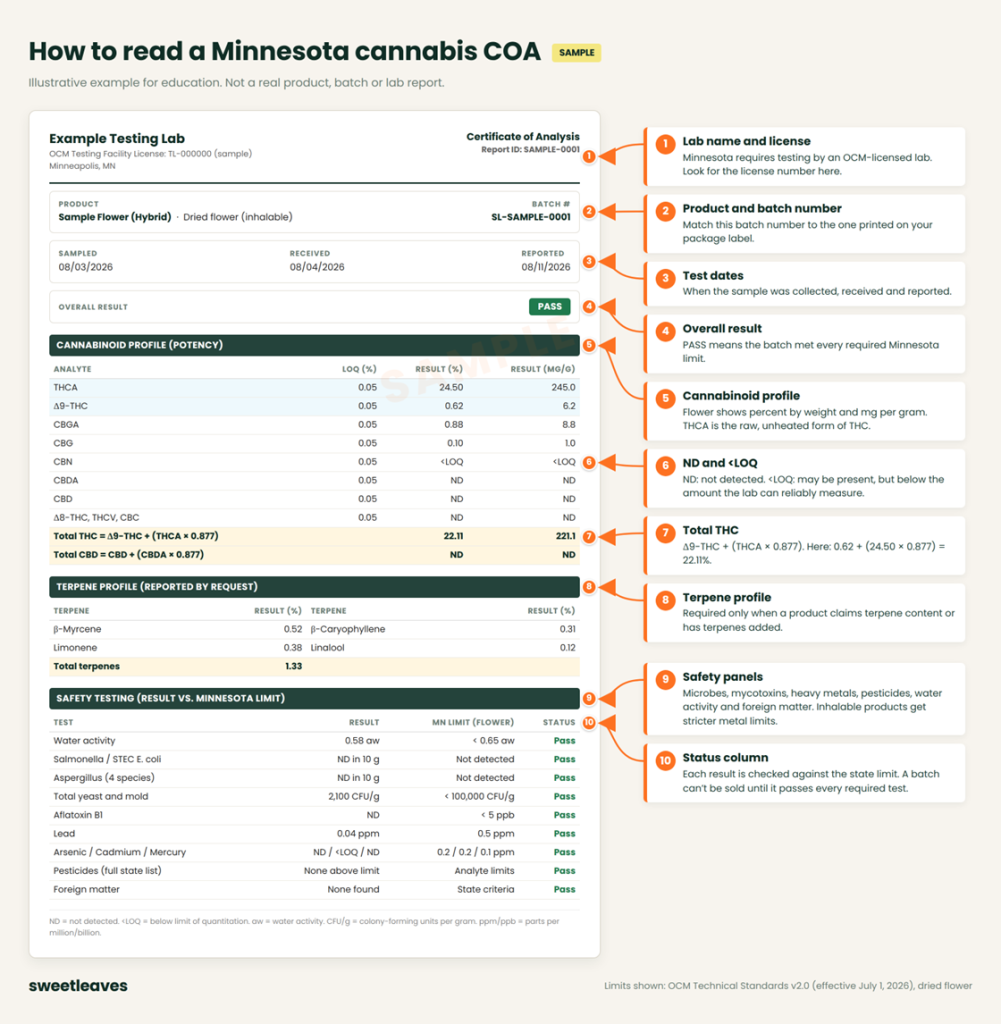
Sample COA for illustration only. Limits shown reflect OCM Technical Standards v2.0 for dried flower.
Lab name, license and batch number
Start at the top. The lab should list its OCM testing license, and OCM’s product testing page lists every licensed facility.
The batch number on the COA should match the batch number on the package, which Minnesota requires on every cannabis label (Minn. Stat. 342.63). A mismatch means the COA describes a different batch.
Test dates and overall result
A COA shows when the sample was collected, received and reported. Below that sits the overall result: PASS or FAIL. A batch that fails can’t be sold as is, and any retest or post-remediation result has to be noted on the COA.
Cannabinoid profile
The potency table lists each cannabinoid the lab measured. Minnesota’s standard panel covers delta-9 THC, THCA, CBD, CBDA, CBN, CBG, CBGA, delta-8 THC, THCV and CBC.
Flower results usually appear two ways: percent by weight and milligrams per gram. The conversion is simple, since 1% equals 10 mg per gram. Edibles are labeled in milligrams per serving and per package, so check those figures on an edible COA.
How to calculate total THC
Total THC equals delta-9 THC plus THCA multiplied by 0.877, the formula written into Minnesota’s testing standards. THCA is the form found in raw flower. Heat converts it to THC, and the molecule loses some mass along the way, which is where 0.877 comes from.
Using the sample COA above:
- Multiply THCA by 0.877: 24.50% × 0.877 = 21.49%.
- Add delta-9 THC: 21.49% + 0.62% = 22.11% total THC.
- Convert to milligrams: 22.11% × 10 = 221.1 mg of THC per gram of flower.
Total CBD uses the same math: CBD plus CBDA × 0.877. Total THC describes what a product contains, not how it will feel. A low starting dose is the sensible default whatever the number says.
What ND, LOD and LOQ mean
ND means not detected: the lab found nothing above its limit of detection (LOD), the smallest amount it can tell apart from a blank sample. “<LOQ” means the compound may be present, but below the limit of quantitation (LOQ), the smallest amount the lab can report as a reliable number.
Minnesota’s standards require labs to report detection or quantitation limits alongside results. On a contaminant line, ND is the result to look for.
Terpene profile
Terpene results are optional on most Minnesota COAs. OCM requires terpene testing only when terpenes were added or the label makes a terpene claim, and those results must fall within 15% of the claim.
When a profile is listed, terpenes appear as a percent by weight, often led by compounds such as myrcene, limonene and caryophyllene. For what research does and doesn’t show about individual terpenes, read the Sweetleaves guide to cannabis terpenes.
Minnesota testing limits cannabis products must pass
The safety panels show whether a batch cleared Minnesota’s contaminant limits. Each line lists the result, the state limit and a pass or fail status. OCM’s Technical Standards v2.0, effective July 1, 2026, set those limits for water activity, microbes, mycotoxins, heavy metals, pesticides, foreign matter and residual solvents. The table covers dried flower, which gets the broadest panel, plus solvents for extracted concentrates.
| Test | What it screens for | Minnesota limit (dried flower) |
| Water activity | Available water that can support mold and microbial growth | Below 0.65 aw (edibles: below 0.85 aw) |
| Pathogenic bacteria | Salmonella and Shiga toxin-producing E. coli (STEC) | Not detected in 10 g |
| Aspergillus | Four mold species | Not detected in 10 g |
| Yeast and mold | Total count | Below 100,000 CFU/g |
| Mycotoxins | Toxins produced by certain molds | Aflatoxin B1 below 5 ppb; other aflatoxins and ochratoxin A below 20 ppb |
| Heavy metals (inhaled products) | Arsenic, cadmium, lead, mercury | 0.2, 0.2, 0.5 and 0.1 ppm |
| Pesticides | A state list of more than 60 pesticides | Fails if any listed pesticide is above its limit |
| Foreign matter | Hair, insects, glass, metal and similar material | Fails above 5% by mass (1% for sharp or hard material) |
| Residual solvents (extracted concentrates) | Solvent left over from extraction | Set per solvent; benzene limit is 1 ppm for inhaled products |
Products that aren’t inhaled have their own heavy-metal limits: arsenic 1.5 ppm, cadmium 0.5 ppm, lead 0.5 ppm and mercury 3 ppm.
A passing COA means a batch met Minnesota’s standards when it was tested. It doesn’t make a product risk-free, and it can’t predict how a product will feel.
How to check a COA against the product on the counter
Checking a COA comes down to five matches: batch, lab, date, result and potency. These steps work for flower, vapes, concentrates and edibles sold at any licensed Minneapolis dispensary. The first step matters most, since a COA only describes the batch it names. If anything doesn’t line up, ask a budtender to pull the COA for that exact batch.
- Match the batch number on the COA to the batch number on the package label.
- Confirm the lab holds an OCM testing license.
- Check the report date and look for any note about a retest or remediation.
- Find the overall result, then scan the safety panels for any FAIL.
- Compare total THC, or milligrams per serving, to the label. Minnesota requires measured cannabinoids to fall within 15% of the label claim.
Where to find and use a COA at a Minneapolis dispensary
Every licensed cannabis or hemp business in Minnesota must make its test results available to members of the public on request, and those results must be in plain language (Minn. Stat. 342.61, subd. 5).
Businesses also have to keep test results for at least five years, so results for past batches should still be on file.
Some brands print a QR code that links to the COA. Minnesota rules don’t let a QR code replace required label information, so the batch number and cannabinoid profile still appear on the package itself. The same testing law covers hemp-derived THC products sold outside dispensaries, so the right to ask for results applies there too.
At Sweetleaves North Loop at 905 N Washington Ave in Minneapolis, a budtender can pull up the COA for a product before checkout. Sweetleaves edibles results are also posted on the Sweetleaves certificate of analysis page.
For flower, the numbers worth comparing across batches are total THC, the report date and the terpene profile when one is listed; the flower category on the Sweetleaves menu shows the batches currently in stock. For THC edibles, the per-serving number on the COA is the one that drives dosing. First-time shoppers can find accepted IDs, purchase limits and what happens at the counter in the Sweetleaves Cannabis 101 guide.
Frequently asked questions
What is a COA for cannabis?
A COA, or certificate of analysis, is a lab report for a single batch of cannabis. It lists cannabinoid content and results from required safety tests for microbes, heavy metals, pesticides and more.
How is total THC calculated from a COA?
Multiply THCA by 0.877 and add delta-9 THC. Flower with 24.50% THCA and 0.62% delta-9 THC has 22.11% total THC.
What does ND mean on a COA?
ND means not detected. The lab found no amount of that compound above its limit of detection.
What does <LOQ mean on a cannabis lab report?
<LOQ means below the limit of quantitation. The compound may be present, but in an amount too small for the lab to report as a reliable number.
Do Minnesota COAs have to list terpenes?
Not always. OCM requires terpene testing only for products with added terpenes or a terpene claim on the label.
Is a COA available before buying at a Minneapolis dispensary?
Yes. Minnesota law requires licensed cannabis and hemp businesses to share test results with anyone who asks, in plain language (Minn. Stat. 342.61).
Sources
Warning: Cannabis products are not for use by anyone under the age of 21. Cannabis use may cause drowsiness, affect focus, reaction time, and decision-making. These products are not evaluated or approved by the FDA. Pregnant people should avoid cannabis due to the risk of low birth weight, premature birth, stillbirth, and harm to fetal brain development.
This content is for general informational and educational purposes only and is not legal, medical or professional advice. Cannabis laws and testing standards change, so verify current requirements with the Minnesota Office of Cannabis Management or a qualified professional before acting on this information.
For adults 21+. Keep out of reach of children. Minnesota-compliant products. License # MICRO-L24-000257.